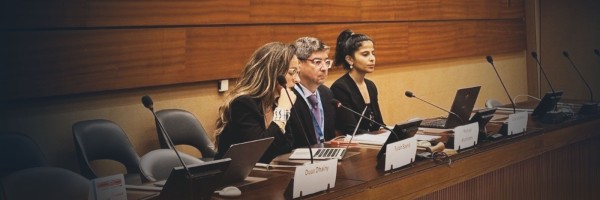
On 12 December 2025 ALQST’s Annual Conference, traditionally held close to Human Rights Day, brought activists, experts, academics and journalists together to hone a shared strategy for countering human rights abuses and demanding accountability in Saudi Arabia in 2026. You can find some of the highlights of the day below, or watch the video here.
English session
Dania Akkad, Deputy Editor of Declassified UK and former Senior Investigations Editor at Middle East Eye, spoke about the challenges journalists face when covering Saudi Arabia. She highlighted the difficulty of verifying information, much of which comes second- or third-hand, and the need to protect sources from reprisals in a climate of fear and constant repression. She noted that while it can be hard to identify successes in an authoritarian state like Saudi Arabia, where progress is often incremental, there have been some notable wins. These include securing consular visits, reducing sentences, and companies withdrawing from the Neom megaproject following ALQST’s research and subsequent media coverage.
James Lynch, founding co-director of FairSquare, spoke about transnational repression by the Saudi authorities. He was concerned that host governments – the UK being a case in point – often do not take the repression of Saudi diaspora communities seriously, and fail to collect the data on frequent low-level incidents that would reveal broader patterns. Beyond acts carried out on foreign soil, Saudi authorities also exert pressure on Saudis abroad through threats to their families at home, creating a chilling effect. Lynch argued that Jamal Khashoggi’s murder signalled how far Mohammed bin Salman was willing to go to silence dissent, but after some damaging blowback that cost him a lot to repair, he transitioned to a pattern of more low-level harassment. Earlier this year FairSquare, ALQST and the Bahrain Institute for Rights and Democracy (BIRD) submitted evidence to the UK Parliament’s Joint Committee on Human Rights as part of its inquiry into transnational repression.
Maryam Aldossari, an ALQST board member, Senior Lecturer at Royal Holloway University, and spokesperson for the NAAS Party, spoke about the vital role of Saudi activists. She explained that being a Saudi activist abroad is not easy, but many have no choice. At least they are able to speak out without fear of arrest. She highlighted how women activists in particular face constant harassment on social media, including sexualised attacks and misogynistic slurs. The unrelenting stress can become debilitating – there is no way ever to fully switch off. Separated from family and subjected to cyber-surveillance, it is the belief that they are speaking on behalf of those who cannot that keeps them going.
Aldossari said that while “women’s empowerment” is a central part of the Vision 2030 narrative, highlighted by figures such as the “first woman ambassador” and the first woman to climb a mountain, these examples do not reflect the reality of most Saudi women. Authorities boast of increasing female employment, but this has largely occurred in a narrow range of male-dominated sectors where women often face poor conditions and routine harassment, according to human rights groups. She argued that urgent priorities for women in Saudi Arabia include abolishing the Personal Status Law that criminalises women’s undefined “disobedience”; allowing independent NGOs to run safe shelters instead of Dar al-Re‘aya; and ensuring genuine, effective legal protection from violence.
Joey Shea, a Saudi Arabia and UAE researcher at Human Rights Watch, discussed the role of international NGOs in addressing human rights violations. She explained that large international human rights organisations rely on intelligence from groups close to people on the ground, while smaller groups benefit from the wider reach of bigger NGOs, making partnerships valuable for both. She highlighted that campaigning around the Riyadh Comedy Festival successfully drew media attention to the human rights situation in Saudi Arabia, but failed to persuade celebrities to call for Manahel al-Oteibi’s release. While major organisations like Amnesty International and Human Rights Watch are effective at reaching traditional media, Shea noted that conversations about the authorities’ attempts at whitewashing through such events are increasingly happening on platforms like TikTok, and NGOs need to be better connected to those spaces.
Julia Legner, Executive Director of ALQST, highlighted the organisation’s unique position: rooted in Saudi society yet based in London, allowing independent action supported by diaspora networks. ALQST documents and archives human rights violations, sharing findings with international institutions and preserving evidence for future accountability. For 2026, ALQST will focus on priorities including promoting the link between business and human rights by helping companies conduct due diligence; advancing women’s rights, particularly regarding “disobedience” and domestic violence laws; and supporting the Saudi diaspora through assistance for new asylum-seekers and training the next generation of human rights defenders.
Yahya Assiri, a leading Saudi human rights defender and founder of ALQST, recalled the background to the organisation’s establishment in 2014. He noted the importance of online forums in the 2000s, where he and others used anonymous accounts to discuss issues such as poverty, unemployment and political repression. Key developments that further shaped his activism included a December 2003 petition by over 100 Saudi reformers, the work of the “Jeddah reformers”, the founding of Saudi rights groups such as ACPRA, and inspiration from Shi’a activists in the Eastern Province influenced by Bahrain’s human rights movement. As Saudis increasingly demanded basic rights after the 2011 Arab Spring, authorities tightened restrictions, detaining many activists, including ACPRA members. In 2013, Assiri left for the UK and saw the pressing need to establish an organisation abroad that could support and build on the work of pioneering Saudi activists inside the country.
Catriona Fraser, migrant worker rights researcher at the Business and Human Rights Centre (BHRC), discussed the systemic abuses faced by migrant workers in Saudi Arabia, including wage theft, forced labour, and poor health and safety protections. She highlighted BHRC’s report We Were Treated as If We Were Machines, which examines migrant workers powering Saudi Arabia’s energy transition. Despite projects like Neom Green Hydrogen being promoted as “sustainable”, they are marked by serious human rights violations. Fraser stressed that companies can use conditionality to push for change by stating that they will disengage “if” issues are not addressed, or will not proceed “unless” standards are met. Businesses and investors must conduct rigorous, migrant-centered due diligence, engage with unions in workers’ home countries, and remain alert to the risks of subcontracting.
In the Q&A discussion, speakers addressed the upcoming 2034 World Cup. While not outright opposing the tournament in principle or calling for it to be boycotted, they emphasised that FIFA should not have awarded it to Saudi Arabia due to the severity of outstanding human rights risks, and authorities must not be allowed to use it for whitewashing. Meanwhile, the stark contrast between extravagant state-sponsored megaprojects like the Trojena ski resort and ordinary Saudis’ everyday problems such as poverty and poor infrastructure vividly make the case that vanity projects are not a responsible use of national wealth. On the advocacy front, the UK government has shown a reluctance to address human rights in the Gulf, instead prioritising export-led economic growth – an intense focus under the Tories that has continued under Labour. Finally, on the current dire situation in Saudi Arabia, speakers emphasised that activists’ work does make a difference. The fight between right and wrong continues, and it is crucial to stay on the side of right, celebrating every small step toward progress.
Arabic session
Khalid Ibrahim, Executive Director of the Gulf Centre for Human Rights and a member of ALQST’s Advisory Board, spoke about the sharp and systematic decline in human rights conditions in the Gulf states, explaining that what the region was witnessing was not just a temporary deterioration or a collection of mistakes but the result of long-term official policies directly aimed at neutralising human rights defenders and emptying the public space of any independent voice. He pointed out that the first generation of human rights activists in the Gulf had paid an enormous price for their activism, with individuals suffering a range of violations from arbitrary imprisonment to being banned from travelling and working, hounded by the security and judicial authorities, and in some cases even killed. The effect was to smash this generation and weaken the traditional infrastructure for human rights work. Given this bleak reality, we have to count today on the younger generation, Khalid emphasised, not just to fill the vacuum but to rebuild the human rights movement with new tools and more flexible methods. He said the classic human rights mechanisms, both international and regional, were no longer sufficient or effective in the face of governments that do not comply with international law or show any interest in accountability. This calls for the development of creative strategies in human rights work, tailored to the nature of the existing regimes.
Jawad Fairooz, the Chair of Salam for Democracy and Human Rights and a former Bahraini Member of Parliament, then took the audience back to the historic roots of the Bahraini struggle, tracing the progress of the Bahraini people’s efforts since independence from Britain to build a state based on rights, institutions and the rule of law. He emphasised that the political and human rights gains that had been achieved had not been granted by the government but hard won by the efforts of reformers and popular movements over a long period. Yet according to Fairooz this progress had suffered a severe setback, with mounting repression, as the Bahraini authorities embarked on policies to systematically clamp down on citizens and activists, including arrests, withdrawal of nationality, and the prosecution of dissidents, even targeting former parliamentarians – something he had personally experienced. He also highlighted the pivotal negative role played by regional actors Saudi Arabia, the UAE and the other Gulf states in blighting the human rights situation in Bahrain, especially during the 2011 uprising, through military and security intervention and direct participation in crushing the popular movement. This further compounded the crisis and turned it from being a domestic matter into a model of Gulf intervention in the suppression of popular demands.
The Saudi academic Dr Maryam Aldossari, also a member of ALQST’s Board of Directors, gave an in-depth critical reading of the nature of human rights work in Saudi Arabia, focusing on the role assigned to activists in the context of a closed political environment. She said that despite all the restrictions human rights work continues to have a tangible impact, albeit not at the desired level because of the lack of a political will to respond. Aldossari dwelt in particular on the question of women, explaining that women were being brought into the labour market rapidly and under slogans of reform, but without the support of a comprehensive legal framework to protect women’s rights in the working environment. As a result, women came under dual pressure, caught between traditional social customs and abuses in the workplace, given the weakness of the law and mechanisms for accountability, and making talk of “empowerment” more a matter of appearances than of rights. She also touched on “The Line” project, describing the proposal as unrealistic and divorced from the socioeconomic context. A recent report in the Financial Times had uncovered a lot of facts missing from the official propaganda, such as that international consultancy firms’ involvement was driven by profit, despite their realising that the project was unfeasible and could not be delivered. In conclusion, Aldossari stressed that there needed to be a shift from individual action to collective and institutional action, and that rights were not something granted by the government but knowledge that had to be owned by society; awareness of a right is the first step to protecting and defending it.
ALQST founder and board member Yahya Assiri focused on the importance of human rights work as a strategic tool to change the Gulf scene in the long term. He explained that the widescale repression in Saudi Arabia made simply expressing an opinion really dangerous. However, this did not negate the need for human rights work but in fact made it more urgent. He said defending human rights was not done with the aim of taking power or contesting it, but was a moral and humanitarian position seeking to safeguard human dignity, document violations and expose them to domestic and global public opinion. Assiri also stressed the importance of connecting those inside the country with the outside world through international organisations and the media, without which the repression and abuse would reach still harsher levels. He said human rights work was a long haul needing patience and persistence, and that the sacrifices made along the way needed to grow out of belief in the principle, not expectation of quick results or formal recognition.
The final speaker, Emirati rights activist Ahmed Al-Shaiba, president of the International Institute for Studies and Development, talked about the Gulf states’ alliance in clamping down on human rights, with a special focus on the role played by the UAE. He described the situation there as a glaring example of “opening up economically while closing down politically”. The state is held up to the world as a model of tolerance and stability, whereas the reality entails gross violations including arbitrary arrests, withdrawal of citizenship, unfair trials and even deaths in custody without independent investigations or transparency. Al-Shaiba explained that Gulf security cooperation was not built to protect societies but has turned into a tool for reciprocal repression and persecution, distorting peaceful demands for rights into charges of terrorism and working for foreign interests. He said the demands raised by Emirati citizens were essentially for reform, seeking to improve the state politically and in matters of rights, but the official response was one of total repression. He therefore appealed directly to society to break down the barrier of fear, saying that silence is no guarantee for the future, and states’ real strength is measured not by their grip on security but by their capacity to reform, listen to their citizens, and contain rather than smother their differences.