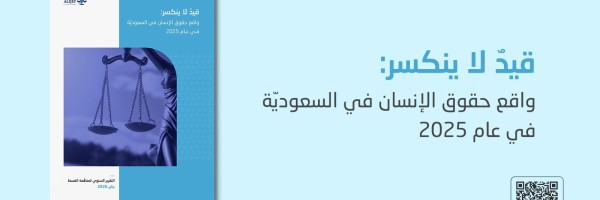
"Still Not Free", this year’s in-depth annual report of ALQST for Human Rights, documents and discusses key human rights developments in 2025.
Introduction
Welcome to the 11th edition of ALQST’s Annual Report, which reviews the state of human rights and key rights-related developments in Saudi Arabia over the past year, based on our extensive monitoring.
Taken together, the reports published since ALQST’s establishment in 2014 trace Saudi Arabia’s largely regressive human rights trajectory over the past decade. They document systemic and long-standing violations; the brutal crackdowns that followed the accession to power of King Salman and his son Mohammed bin Salman; the announcement of reforms amid intense international scrutiny, and revulsion over the assassination of journalist Jamal Khashoggi; and, as that scrutiny and revulsion faded amid shifting geopolitical priorities, the resurgence of repression and the failure to deliver genuine reform, contrary to the authorities’ official narratives and carefully crafted public image.
ALQST has consistently welcomed genuine progress or concessions from the authorities when these occur. The early months of 2025 brought some positive developments, notably the release of scores of prisoners of conscience, albeit only after they had served lengthy and unjust sentences. However, as the title of this year’s report, Still Not Free, reflects, such measures have done little to create real freedom or dispel the prevailing climate of fear throughout the country. The prisoners who were released remain under severe restrictions including travel bans; numerous prisoners of conscience continue to be held arbitrarily, or face fresh prosecution; executions have continued to soar, reaching a record high for the second consecutive year; and women and migrant workers still face entrenched discrimination, despite official claims to the contrary.
This year’s report is a reminder that, even as Saudi Arabia increasingly makes international headlines for its expanding global influence, ambitious mega-projects, and role in hosting high-profile sporting events, the reality behind this glittering façade continues to be one in which many citizens and residents endure harsh repression and their basic rights are denied.
In today’s challenging global context, marked by rising authoritarianism and sudden crises, and as Saudi Arabia’s international role continues to grow, the struggle between right and wrong goes on. It is vital that those with the ability and platform to do so stand on the side of right and justice, amplifying the plight of courageous activists and marginalised voices inside Saudi Arabia.
We encourage you to read this Annual Report carefully and visit our website to learn how you, whether Saudi or non-Saudi, can support the struggle for human rights for all in Saudi Arabia.
Thank you.
Julia Legner, Executive Director of ALQST