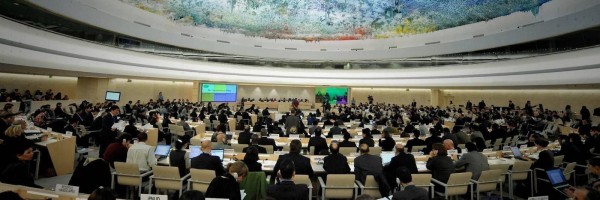
During the 61st Session of the UN Human Rights Council (23 February – 31 March 2026), ALQST and the Gulf Centre for Human Rights delivered two joint oral statements highlighting urgent human rights concerns in Saudi Arabia and the wider region.
The first statement addressed deeply regressive trends relating to the death penalty in the country, highlighting a record surge in executions—particularly for non-violent drug-related offences—the use of the death penalty to suppress freedom of expression, and the resumption of executions of child defendants.
The second statement was addressed to the Special Rapporteur on human rights defenders, Mary Lawlor, as she presented her final report to the UN Human Rights Council at the end of her mandate. It highlighted the continued repression of, and restrictions on, human rights defenders in the MENA region and among those living in the diaspora, and raised concerns about the impact of state funding cuts.
Both statements can be read in full below.
Joint oral statement on the execution crisis in Saudi Arabia (Item 4)
Mr. President,
The Gulf Centre for Human Rights and ALQST for Human Rights wish to draw attention to the execution crisis in Saudi Arabia.
Saudi Arabia has for years been among the countries carrying out the highest number of executions in the world. Yet despite pledges from Saudi Arabia’s Crown Prince Mohammed bin Salman to reduce the use of the death penalty, the rate of executions has continued to soar to record levels.
2025 saw the highest execution toll ever recorded in the country, with at least 356 individuals executed, surpassing the previous year’s record toll of 345. This trend is continuing in 2026, with 39 individuals executed already.
Of those executed last year, more than half were for non-violent drug-related crimes, with foreign nationals accounting for the vast majority. Their executions follow a pattern of abuses, including lack of access to court documents and legal representation.
Other regressive trends in 2025 included the use of the death penalty to suppress freedom of expression, with Saudi journalist Turki al-Jasser executed in June, showing the results of the international community’s failure to deliver justice for Jamal Khashoggi.
And 2025 also saw the resumption of executions of child defendants, with Saudi youths Jalal Labbad and Abdullah al-Derazi executed in August and October respectively, convicted of offences connected to allegedly attending protests when they were minors. This invalidates the authorities’ claim to have ended this practice, and other child defendants remain at imminent risk of execution.
Governments should immediately press Saudi authorities to end these deplorable practices, in violation of international human rights law.
Joint oral statement during the interactive dialogue with the Special Rapporteur on human rights defenders
Dear Mr/s (Vice) President,
We would thank the Special Rapporteur for the final report of her mandate and take the opportunity to thank for her tireless efforts during the last six years. Dear Mary, your efforts have been truly appreciated by so many within the human rights community.
Despite severe restrictions on, and repression, of human rights defenders in the MENA Region, your report outlines the powerful motivations and spirit that keep human rights defenders going. Across the World you note that Human Right Defenders often start their activism based on personal experiences of injustice of those they have witnessed. This shows a universality to the reaction against injustice and human rights violations.
Across MENA, in particular the Gulf and neighbouring States any criticism of the authorities is immediately silenced through threats and prosecution. Even if released they can face travel bans and being forced into silence.
Thus, most of the free voices are members of the diasporas in countries where it is safer to speak out. In many cases, they operate on tiny budgets where only deep commitment keeps the core of their activities going. Even there they suffer transnational repression in many forms including: Interpol arrest warrants, extradition when travelling, Digital surveillance, on-line reputational attacks, as well as pressure and travel bans on family members.
This report outlines the impact of funding cuts by states who support human rights and have provided much of the funding. The consequences outlined are only the beginning and along with cuts to the UN itself, will lead to less human rights capacity worldwide.
Madame Special rapporteur, among your comprehensive recommendations to states, which one is the one you highlight as needed to enhance the protection of W/HRDs?