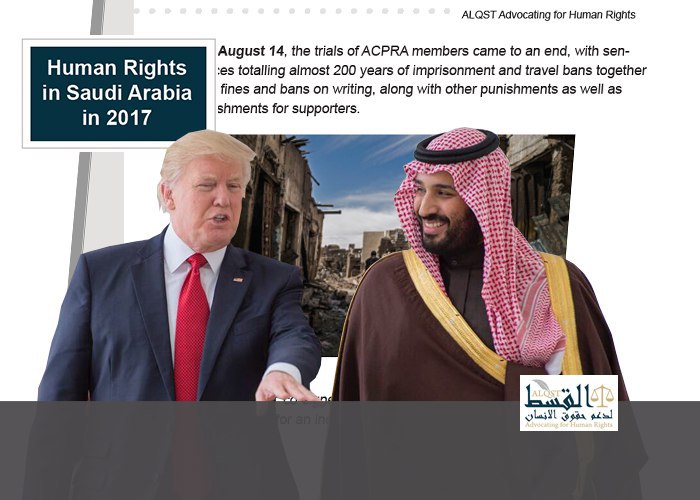
Crown Prince Mohamed bin Salman returns to Saudi Arabia this weekend at the end of a five-week, five-nation “charm offensive” aimed at selling a dubious image of modernisation and social reform at home, in exchange for diplomatic backing and multimillion-dollar trade deals.
Prince Mohamed is undoubtedly driving sweeping changes in the kingdom, but in terms of basic human rights and liberties, things that his Western hosts claim to value and champion elsewhere, there has been no sign of radical reform. During the Crown Prince’s absence – in Egypt, the UK, US, France and Spain – eleven more people were executed in the kingdom, five of them at judges’ individual discretion for non-violent crimes.
Prisoners of conscience remain locked up – some of them tried and sentenced for peaceful human rights activism, others held arbitrarily for their academic or journalistic work or personal political views.
Mohamed bin Salman has delighted Westerners, whose governments eagerly supply his military with warplanes and other equipment, by promising that women will soon be allowed to drive in Saudi Arabia, the only country in the world where they cannot already do so.
Meanwhile, Saudi women themselves are demanding an end to the male guardianship system that allows men to control the lives of their wives, daughters, sisters and mothers.
The Crown Prince’s PR gambit in the West, although lavishly financed and professionally executed, should not convince anyone, and indeed has not persuaded everyone, that he deserves their trust and praise.
In Seattle, for example, where he attended the signing of a military aircraft maintenance deal with Boeing, the city’s mayor and the state governor were “too busy” to meet him, while local activists denounced him as “a war criminal” for launching deadly airstrikes that have created a humanitarian catastrophe in Yemen.
ALQST notes that it is a crime in Saudi Arabia, under the country’s Counter-terrorism law, to criticise the Crown Prince or his father, King Salman. ALQST continues to call on the Saudi authorities to introduce genuine reforms that safeguard the civil, political and basic human rights of all citizens and residents; to release prisoners of conscience immediately and unconditionally; and to involve civil society in building a truly modern state of rights and institutions. ALQST also urges the governments and peoples of the world to put moral values and human rights ahead of oil and weapons deals. To learn more about the human rights situation in Saudi Arabia, see ALQST’s latest comprehensive report:
HR Situation in Saudi Arabia, ALQST Annual review تقرير القسط السنوي – https://t.co/r4JMDKc8Yt pic.twitter.com/J2zIw5TNqb
— القسط ALQST (@ALQST_ORG) April 10, 2018