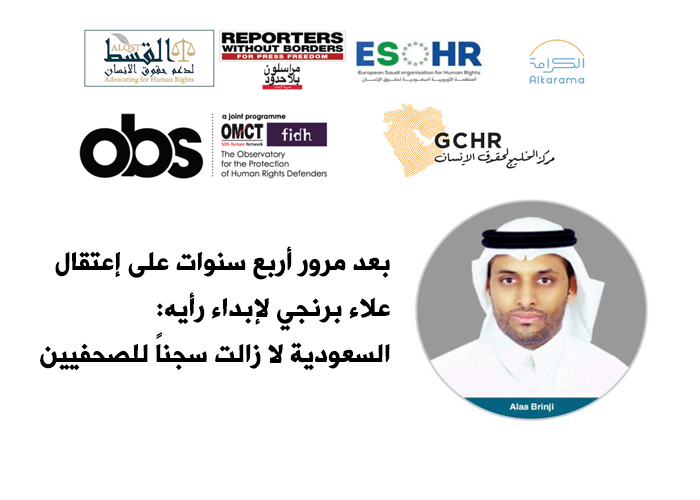
Four years after the arrest of Alaa Brinji for expressing his opinion: Saudi Arabia remains a prison for journalists.
As of May 14, 2018, Saudi journalist Alaa Brinji has spent four years behind bars for expressing his opinion, advocating for human rights, and challenging rights violations.
Brinji, who used to write for Al-Bilad, Al-Sharq and Okaz newspapers, is one of Saudi Arabia’s best-known journalists. His arrest was accompanied by several violations of his rights, including initially being held incommunicado, denied contact with the outside world, and denied access to a lawyer throughout his trial.
Brinji was brought before the Specialised Criminal Court, the infamous Saudi court that deals with terrorist cases, and charges were brought against him for expressing his opinions on social media. The charges were based on Twitter posts in which Brinji had backed the right of women in Saudi Arabia to drive, and supported human rights defenders and prisoners of conscience.
In March 2016, Brinji was sentenced to five years in prison followed by an eight-year travel ban, together with a fine. Three months later, in June 2016, instead of quashing the charges, the judge increased his jail sentence to seven years.
The fourth anniversary of Brinji’s arrest coincides with Saudi Arabia’s ranking on the Press Freedom Index published by Reporters Without Borders slipping from 168 (out of 180 countries) last year to 169 in 2018. As the Saudi Crown Prince trumpets what is supposed to be a new era of major reforms, with promises to promote free speech, Brinji’s continued detention calls into question the seriousness of the Crown Prince’s assertions and the likelihood of their being realised in practice, so as to give prisoners of conscience their freedom.
By continuing to detain Brinji, along with dozens of other journalists, bloggers, online activists and human rights defenders, and by failing to appoint a lawyer for him, the Saudi government is confirming its intention to maintain its policy of silencing any and all opinion by means of arbitrary arrests, flawed trials and harsh sentences.
We the undersigned call for the immediate release of Alaa Brinjii, and the dropping of the charges, which violate his right to freedom of expression.
Signed,
- RSF Reporters Without Borders
- ALQST
- Alkarama Foundation
- European Saudi Organisation for Human Rights (ESOHR)
- FIDH, within the framework of the Observatory for the protection of human rights defenders
- Gulf Centre for Human Rights (GCHR)
- World Organisation Against Torture (OMCT), within the framework of the Observatory for the protection of human rights defenders