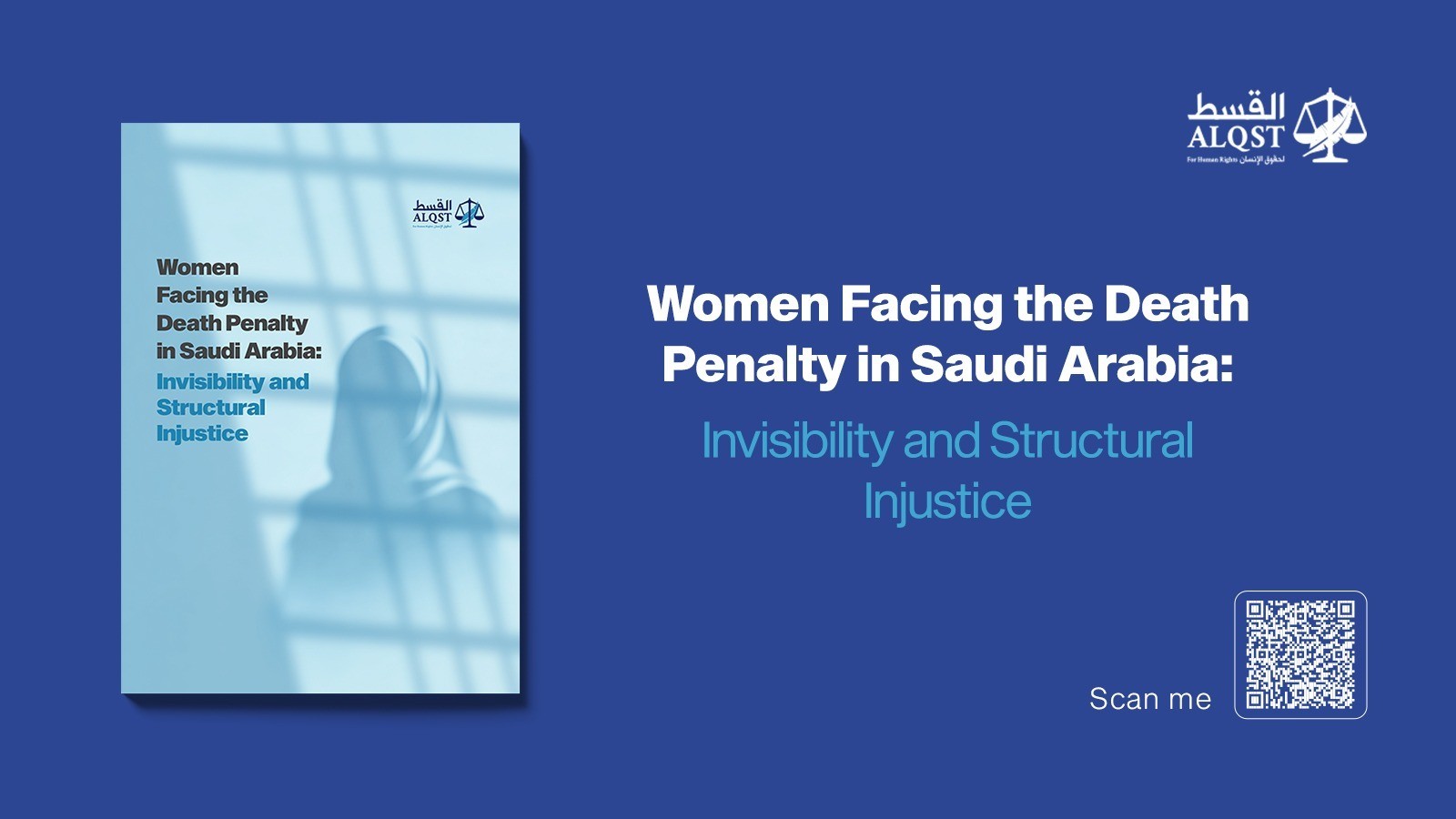
"Women Facing the Death Penalty in Saudi Arabia: Invisibility and Structural Injustice" examines Saudi Arabia’s use of the death penalty through a gendered and intersectional lens, with particular attention to migrant women.
Introduction
This report examines Saudi Arabia’s use of the death penalty through a gendered and intersectional lens, with particular attention to migrant women. It exposes how gender, migration status, race and class combine to shape vulnerability within the Saudi criminal justice system. Migrant women – especially domestic workers – are positioned at the intersection of these risks, but Saudi women are also executed at roughly the same rate, demonstrating that gendered vulnerability operates across citizenship status.
The analysis brings together a review of existing documentation – including UN human rights mechanisms, international NGOs, ALQST’s monitoring, and media investigations – with limited primary information gathered through families of affected women and civil society actors. Efforts were also made to engage embassies representing the women’s countries of origin. The restricted access to official and diplomatic sources reflects the highly opaque and politically sensitive environment in which these cases occur.
The report focuses not on the death penalty itself but on how women experience the system in Saudi Arabia in practice, through arrest, interrogation, trial and detention, highlighting recurring issues such as the absence of legal representation, language barriers, pressure to sign documents or confessions, and the lack of timely or effective consular support, while families are often left without information or means to intervene.
By consolidating available evidence and situating it within a gender- and migration-aware framework, this report aims to clarify how women come to face capital punishment in Saudi Arabia and why their cases remain largely invisible. The analysis informs the findings and recommendations that follow and provides a foundation for targeted policy and advocacy engagement.